“Therefore let us also, seeing we are surrounded by so great a cloud of witnesses, lay aside every weight and the sin which so easily entangles us, and let us run with perseverance the race that is set before us.” (Hebrews 12:1, WEB)
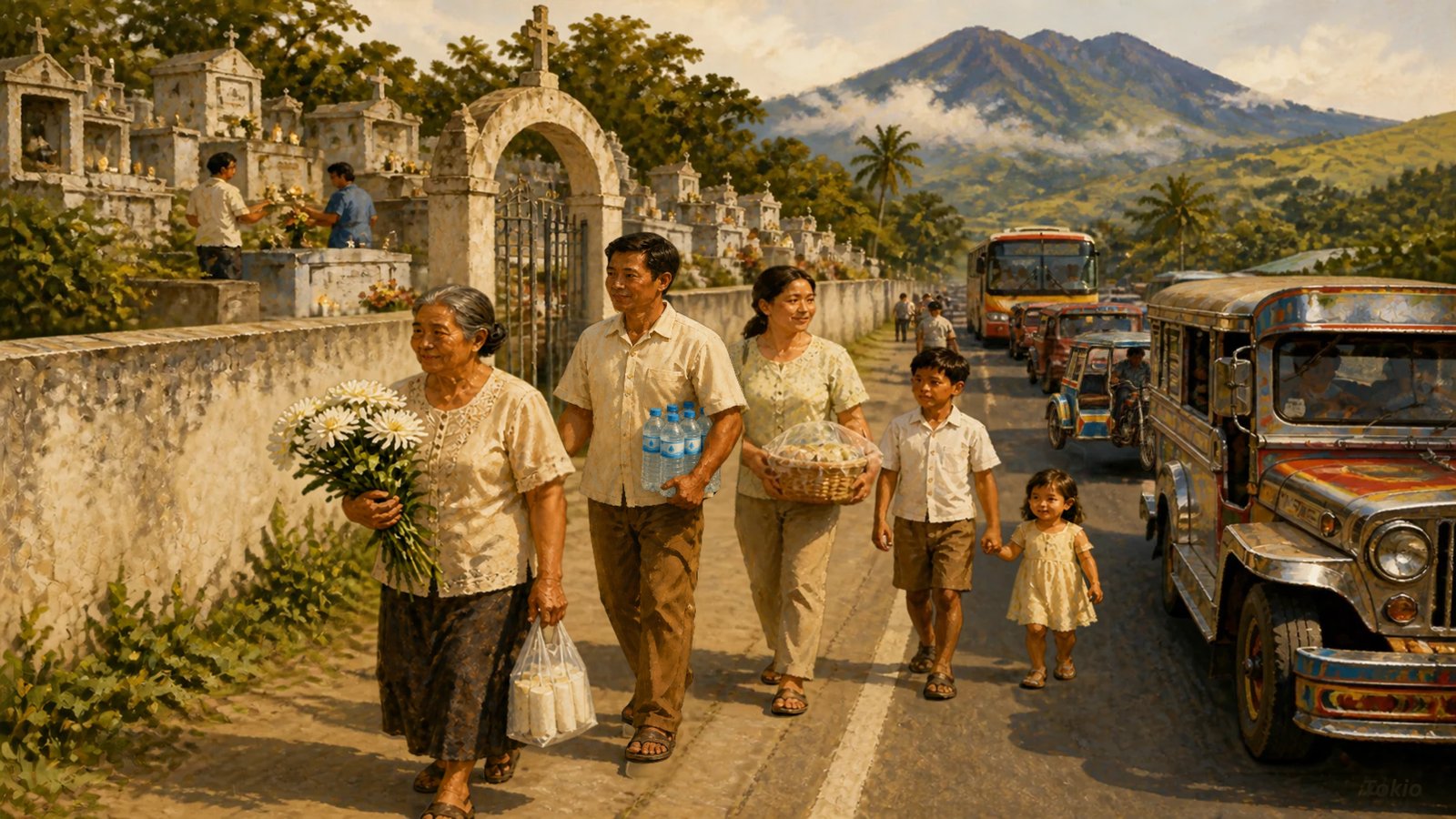
This weekend, most of the Philippines is on the move. Families are packing food, buying candles and flowers, and heading home to the graves of parents, grandparents, and children they still miss. Here in Olongapo, that movement funnels onto a single highway, and it passes right by two cemeteries on its way in and out of town.
We have lived through enough Undas weekends now to know the rhythm. What follows is our attempt to explain it to friends and supporters who have never seen it: what the weekend means, where it came from, how it is changing, and what it does to traffic on the only road home.
What Undas means
In everyday Filipino life, the two days have largely merged into one family occasion. People go to the cemetery to clean and repaint tombs, light candles, leave flowers, pray, and simply sit with the dead for a while. Relatives who have not seen each other since last November meet again at the graveside.
The government treats the weekend seriously. For 2026, Proclamation No. 1006 made November 1 a special non-working day and added November 2, a Monday, as an additional special non-working day. The proclamation’s stated reasons were to give families more time for these traditions and to support domestic tourism. That turned this year into a three-day weekend, from Saturday, October 31, through Monday, November 2.
Where it came from
The early church remembered its martyrs from the beginning. In the early 600s, Pope Boniface IV took over the Pantheon in Rome, an old temple to many gods, and dedicated it as a church to Mary and all the martyrs, with a feast on May 13.
The November date came later. Pope Gregory III, who led the church from 731 to 741, dedicated a chapel in St. Peter’s Basilica to all the saints on November 1. In the 830s, Pope Gregory IV extended that November 1 feast from Rome to the whole Western church. All Souls’ Day on November 2 grew up separately, spreading out from the monastery of Cluny in France around the year 1000.
Spanish missionaries brought both days to the Philippines in the 1500s. They landed on soil already prepared for them, since honoring ancestors was part of life in these islands long before the Spanish arrived. Over four centuries the two traditions blended into something recognizably Filipino.
Even the word is local. One common explanation traces Undas to the Spanish honras, meaning honors, as in honors paid to the dead. Another, offered by a Philippine studies professor on GMA News, says it is a Filipino shortening of the Spanish phrase for the Day of All Saints. Either way, the name has stuck far beyond the Tagalog provinces where it started.
How it is changing
There is a quiet bit of church history in this weekend. On October 31, 1517, the eve of All Saints’ Day, Martin Luther posted his Ninety-Five Theses, and many Protestants mark that date as Reformation Day. The Reformers rejected purgatory and prayers for the dead, yet several Protestant traditions, including Lutherans, Anglicans, and Methodists, still keep All Saints’ Day as a time to give thanks for all believers who have died in Christ.
As evangelical and other Protestant churches have grown in the Philippines, Undas has become a weekend that families of different convictions share. In many households, a Catholic grandmother, an evangelical son, and a teenager who rarely attends church all end up at the same tomb. Protestant believers usually still go, clean the grave, and eat with the family. What changes is the prayer at the graveside, which becomes thanksgiving for a life and hope in the resurrection rather than intercession for the departed.
Secular culture is pulling the weekend in another direction. Halloween costume parties, mall promotions, and trick-or-treating in subdivisions now sit beside the candles and flowers. For many families, especially younger ones, the long weekend has become a travel window as much as a time of remembrance, and the government’s own holiday proclamation names domestic tourism as a goal.
Church leaders have noticed. In 2025, a Catholic bishop with the CBCP urged the faithful to recover the original meaning of the eve of All Saints as a night of prayer and remembrance, and said the ghosts-and-costumes version had been popularized by a very secular society. Many Protestant pastors would agree on that point, even while disagreeing on others.
The practical side
The biggest practical fact of Undas is that millions of people travel at the same time. City and provincial governments publish traffic schemes, close side streets, set up help desks near cemeteries, and post police and medics at the gates. Many cities also ban sharp tools, alcohol, and loud speakers inside cemetery grounds during the peak days.
Buses fill up early. In past years, news crews have filmed crowds at the Victory Liner terminal in Cubao, with most passengers bound for Pampanga, Tarlac, Olongapo, and Baguio. This year carries an extra wrinkle: in September, Victory Liner announced it would consolidate some trips because of rising fuel and operating costs. Fewer departures on the same busy weekend means longer lines, so booking ahead matters more than it used to.
Food is part of the visit. Families bring rice cakes like suman and biko, pancit, and whatever their relatives liked best, then eat together beside the tomb. Outside the gates, vendors sell candles, flowers, bottled water, and snacks, and for a few days the cemetery road turns into a small market.
There are smaller costs too. A family may spend the week before Undas repainting a tomb, hiring someone to clear weeds, or paying for a tricycle to carry flowers and folding chairs. For low-income families, the candles, food, and fares add up, and this is one of the more expensive weekends of the year.
Olongapo: one road, two cemeteries
Olongapo sits between the mountains and Subic Bay, and its geography leaves little room for detours. One main road carries nearly everyone through the city. From the south it arrives as Jose Abad Santos Avenue, the highway from Pampanga and Manila, and becomes Rizal Avenue in the city proper. At the Ulo ng Apo rotonda it turns into the National Highway that runs north through Kalaklan and Barretto toward the rest of Zambales.
On an ordinary day that works well enough. On Undas weekend, the road meets a cemetery at each end. Olongapo Memorial Park sits at the south entrance, where traffic from Manila and Pampanga comes in. The other, the Olongapo City Public Cemetery, sits on a hillside along the National Highway in Kalaklan, at the north entrance that leads to Barretto, Subic town, and the Zambales provinces beyond.
The result is two bottlenecks on the only through road. Visitors’ cars and tricycles look for parking along the shoulder, jeepneys stop to unload whole families, and pedestrians carrying flowers and food cross back and forth. Meanwhile, Victory Liner buses and private cars traveling between Manila and Zambales have no choice but to pass through both choke points. A trip across town that normally takes minutes can take far longer.
Those of us who live here plan around it. Many families visit their graves in the days before the long weekend, or go early in the morning before the heat and the crowds. If you are traveling through Olongapo this weekend, leave extra time, carry water, and expect the slowest stretches near the two cemetery gates.
At the main entrance of the north cemetery, travelers can still see an old marker that reads, “Those who honor the dead will care for the living.” Local accounts say it was already standing when Olongapo was turned over to the Philippine government in 1959. It is a good line to read while you sit in traffic.
Grief with hope
For all the traffic and expense, Undas does something good. It sends a whole nation back to its families, and it gives people permission to grieve out loud once a year. Christians across traditions can agree on what Paul wrote to a church that was mourning its dead:
“But we don’t want you to be ignorant, brothers, concerning those who have fallen asleep, so that you don’t grieve like the rest, who have no hope. For if we believe that Jesus died and rose again, even so God will bring with him those who have fallen asleep in Jesus.” (1 Thessalonians 4:13-14, WEB)
If you are on the road this weekend, be patient with the jeepney ahead of you. Most likely it is carrying a family on its way to remember someone they loved.
Sources
- Proclamation No. 1006, s. 2025 (Lawphil)
- All Saints Day: The history and traditions behind the holiday (KVIA)
- Why All Saints’ Day in the Philippines is called Undas (GMA News)
- CBCP official urges faithful to rediscover the true meaning of Undas (Manila Bulletin)
- Passengers bound for Luzon provinces jam QC bus terminal (GMA News)
- Victory Liner cuts trips as fuel costs bite (Daily Tribune)
- Jose Abad Santos Avenue (Wikipedia)
- Olongapo City Public Cemetery (Find a Grave)
- The Inscription at the Olongapo Public Cemetery (Bloggapo)