How a wild banana from these islands rigged the world’s sailing ships, built a city in Mindanao, became a wartime strategic material, and ended up in your tea bag.
Ask most people outside the Philippines what “Manila hemp” is and you will get a blank look. Ask them about manila folders, manila envelopes, or manila rope, and they know exactly what you mean. Few realize that all of those names point back to a single plant that grows on Philippine hillsides, and to the farmers who have harvested it by hand for centuries.
That plant is abaca (in Filipino, abaka). This is its story.
Not Hemp at All
The first thing to know about “Manila hemp” is that it is not hemp. True hemp comes from Cannabis sativa. Abaca, Musa textilis, is a member of the banana family, native to the Philippines. Standing in a field, you would likely mistake it for an ordinary banana plant. Its fruit, however, is small and inedible. The value is in the stalk.
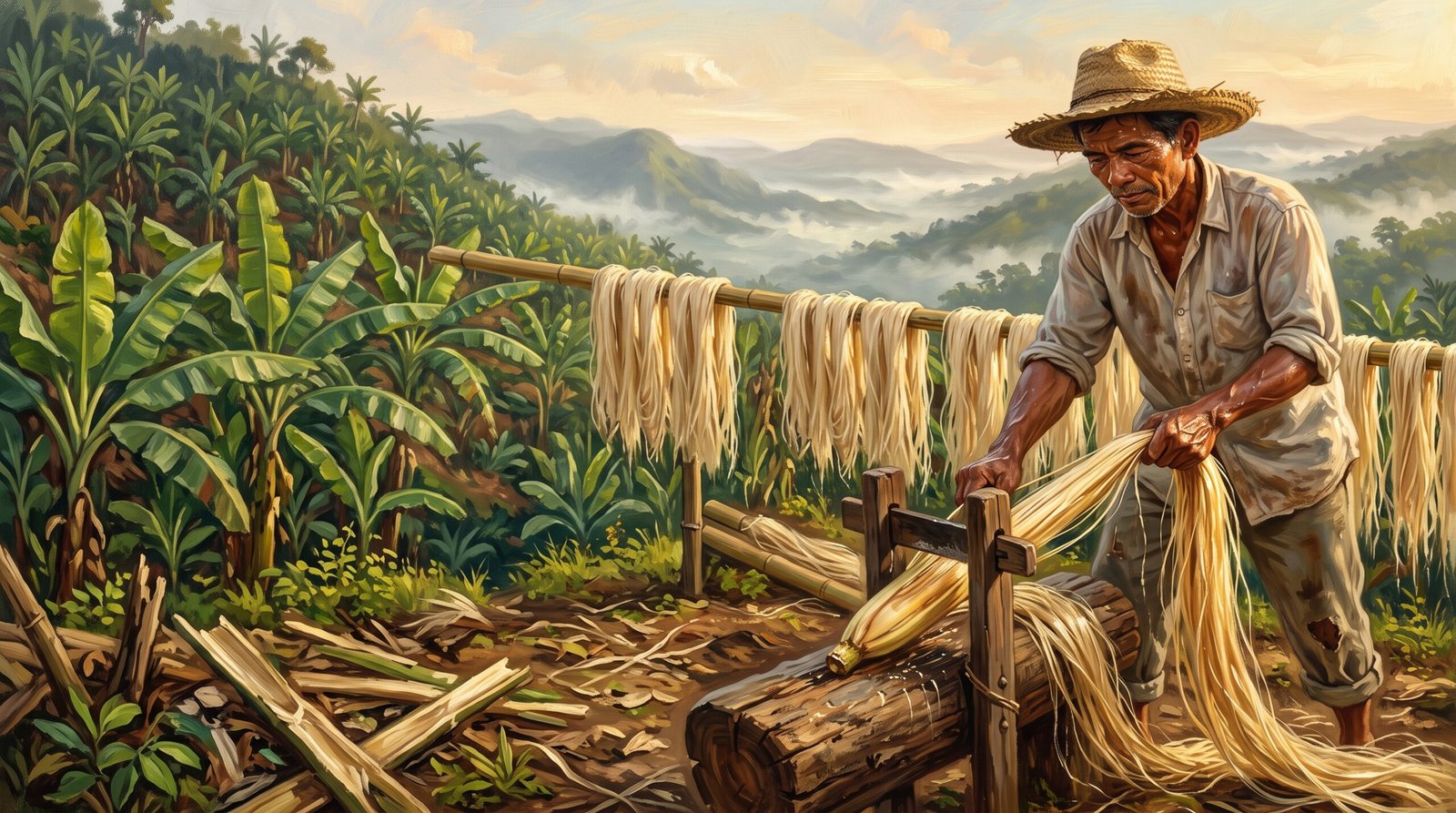
What looks like a banana “trunk” is actually a tightly wrapped bundle of leaf sheaths. Inside those sheaths are long fibers, some running more than three meters in length. Once stripped, cleaned, and dried in the sun, they become one of the strongest natural fibers known. Just as important for its history, abaca fiber floats, stays strong when wet, and resists rotting in salt water. For seafaring nations, that combination was worth a fortune.
The name “hemp” came from foreign traders, who saw it simply as one more fiber that could be twisted into rope. They named it after the port it shipped from: Manila. The chief of the Philippine Bureau of Agriculture’s fiber division was already calling the name misleading in 1915, but by then it had stuck.
Before the Spanish
Abaca was cultivated in these islands long before Europeans arrived. Communities spun and wove it into cloth, and some of those traditions are still alive today. The T’boli of South Cotabato weave t’nalak, a tie-dyed abaca textile whose patterns are traditionally said to come to weavers in dreams. Other Mindanao peoples, including the Bagobo and Mandaya, produce their own abaca cloth known by names such as dagmay and inabal.
Under Spanish rule, abaca cloth was known as medriñaque. It traveled farther than many people realize. Textile historians have found it used for men’s shirts in sixteenth-century Peru, carried there by the galleon trade, and recorded in seventeenth-century English documents as a coarse canvas used for sails and for stiffening collars.
Oddly, Spain itself was slow to see abaca’s greatest value. According to historian Elizabeth Potter Sievert, the Spanish crown rejected abaca rigging for its sailing fleet in the seventeenth century. It would take other naval powers, nearly two hundred years later, to recognize what was growing in the Philippine hills.
The Nineteenth Century: Rope for the World’s Ships
Commercial export of abaca fiber began in a small way in the early 1800s. Around 1820, a U.S. Navy lieutenant named John White carried samples back to the United States, and a cargo soon reached Salem, Massachusetts, labeled simply “Manila.” American shipowners and ropemakers quickly found it outperformed the Russian hemp they had relied on. As Manila opened more fully to foreign trade in the 1830s, American merchant houses such as Russell & Sturgis built a steady business shipping the fiber abroad.
For much of the century, raw abaca crossed the Pacific and was spun into rope in New England mills. The Plymouth Cordage Company in Massachusetts, one of the largest ropemakers in the world, supplied the U.S. Navy with “Manila” line. Over time, more of the ropemaking moved back to the Philippines.
The scale of the trade was enormous. From about 1850 to the end of the nineteenth century, abaca and sugar traded places as the country’s single largest export. By 1897, the Philippines was shipping close to 100,000 tons of abaca a year. The sailing ships, whalers, and early steamships of Britain and America were held together, quite literally, by Filipino labor.
The American Period and the Making of Davao
After the United States took control of the Philippines in 1898, abaca remained the colony’s leading export. Between 1900 and 1914 alone, according to official figures compiled by the Bureau of Agriculture, the islands exported roughly 1.9 million metric tons of the fiber.
Much of the new growth happened in Mindanao. American planters opened abaca plantations around the Davao Gulf in the early 1900s. In 1903, a Japanese businessman named Ohta Kyozaburo began bringing Japanese laborers to the area, and within a year he had founded the Ohta Development Company with his own plantations. Japanese planters introduced mechanized stripping, using a spindle-driven machine that made fiber extraction far faster than scraping by hand.
By 1918, Japanese-owned plantations around Davao outnumbered American ones roughly two to one. The Japanese community grew into the tens of thousands, and the area around Mintal came to be called “Little Tokyo.” Filipino leaders grew uneasy about how much land was passing into foreign hands, much of it ancestral ground of the Bagobo and other Lumad peoples. That concern was one of the reasons Davao was chartered as a city in 1936: the new city’s boundaries were drawn wide enough to bring the plantations under Philippine municipal authority. The modern city of Davao, in other words, was shaped in large part by abaca.
A Strategic War Material
By the 1930s, the U.S. Navy considered Manila fiber the best cordage material available and worried about what would happen if war cut off the supply. In 1937, the Army and Navy Munitions Board officially classified it as a strategic war material, and stockpiles were built up in the United States.
Those fears proved justified. When Japan occupied the Philippines in 1942, the Allies lost their main source of rope fiber at the very moment they were building ships by the thousands. The U.S. government, working with the United Fruit Company, rushed abaca plantings in Panama, the Canal Zone, Costa Rica, Honduras, and Guatemala. Small experimental plantings had existed in Central America since the late 1920s, and the Dutch had grown abaca in Sumatra since 1925, but the war turned these into serious operations. Even so, naval records from 1945 show how close supplies came to running out before Central American fiber arrived in quantity.
In the Philippines, many plantations were damaged or converted to food crops during the occupation, and some were bulldozed for airfields.
Decline and Reinvention
After the war, abaca never regained its old position. Plantations had been neglected or destroyed, plant diseases spread, and, most decisively, nylon and other synthetic fibers took over the rope market. The cheaper petroleum-based ropes did not rot and could be made anywhere. By the 1950s, the industry that had once anchored the Philippine economy was in serious trouble.
What saved abaca was paper. Its long, strong fibers produce a pulp that is thin, porous, tear-resistant, and tasteless, qualities that are hard to find together. Today most of the world’s abaca is pulped into specialty papers rather than twisted into rope. You have almost certainly used it without knowing:
- Tea bags and coffee pods
- Sausage casings and food-preparation papers
- Cigarette and filter papers
- Capacitor paper used in electronics
- Banknote paper, including Japanese yen notes
Philippine peso notes themselves contained abaca for years, though the country has more recently begun shifting to polymer notes. In 2025, the Philippine Fiber Industry Development Authority (PhilFIDA) met with the Banque de France to discuss using Philippine abaca in banknote production.
Newer uses keep appearing. Mercedes-Benz has used a blend of abaca yarn and polypropylene in some automobile body parts, replacing heavier glass fiber. During the COVID-19 pandemic, Philippine researchers developed abaca-based face masks. And abaca has never stopped being woven into bags, mats, hats, home furnishings, and some traditional Filipiniana garments.
Where It Grows Today
The Philippines still supplies roughly 85 percent of the world’s abaca, according to PhilFIDA. Ecuador and Costa Rica, both descendants in a sense of the wartime plantings, account for most of the rest.
Within the country, the Bicol Region is the leading producer, followed by Eastern Visayas and the Davao Region. The island province of Catanduanes is the single largest producing province, and in 2022 Republic Act No. 11700 formally declared it the “Abaca Capital of the Philippines.” In 2025 it contributed about one-fifth of the national harvest.
The People Behind the Fiber
For all its global reach, abaca is still largely a smallholder crop, and much of the stripping is still done by hand. In Catanduanes, the workers who pull the fiber from the stalks are called parahagot. It is hard, repetitive work, and the pay is modest.
The farmers face real threats. Viral diseases, especially abaca bunchy top and abaca mosaic, have destroyed many plantations, and researchers are working to develop resistant varieties. Typhoons are an even more immediate danger. Abaca is a soft-stemmed plant, and a strong storm can flatten an entire hillside. A newly replanted field needs two years or more before it can be harvested again.
Catanduanes has been hit repeatedly. Super Typhoon Rolly in 2020 destroyed an estimated 80 percent of the province’s abaca crop. Super Typhoon Pepito in November 2024 damaged more than 23,000 hectares. Typhoon Uwan in 2025 caused over ₱1.2 billion in losses to the province’s abaca industry and affected nearly 14,000 farmers. Industry figures show national production in 2025 down roughly a quarter from 2014 levels.
There is also a long-standing gap between where abaca is grown and where its value is added. Catanduanes, the country’s top producer, had only three registered processors as of 2025. Much of the fiber still leaves the province, and often the country, before it becomes the products that earn the highest prices. Government programs are now aimed at building more local processing, rehabilitating diseased farms, and getting better planting materials into farmers’ hands.
Why It Matters
Abaca’s story is one of the clearest examples of how deeply the Philippines has been woven into world history, often without the world noticing. For two centuries, foreign navies, merchants, and manufacturers depended on a plant they named after a port rather than the people who grew it. The rope on a nineteenth-century whaler, the line on a wartime destroyer, the envelope on an office desk, and the tea bag in a kitchen in London or Tokyo all trace back to hands in Bicol, Samar, Leyte, and Mindanao.
It is also a story still being written. Abaca is renewable, biodegradable, and strong enough to replace some plastics and synthetic fibers. As the world looks for alternatives to petroleum-based materials, this old Philippine fiber may have a larger future than anyone expected in the 1950s. Whether the farmers who grow it share fairly in that future is a question worth keeping in view.
The next time you see a manila folder, you will know where the name came from.
Sources
- Philippine Fiber Industry Development Authority (PhilFIDA), “PhilFIDA Explores Global Opportunities for Abaca in Banknote Production,” September 2025
- DOST-PCAARRD, Abaca Industry Strategic Plan commodity profile (citing PhilFIDA and Philippine Statistics Authority data, 2025)
- Encyclopaedia Britannica, “Abaca”
- Elizabeth Potter Sievert, The Story of Abaca: Manila Hemp’s Transformation from Textile to Marine Cordage and Specialty Paper (Ateneo de Manila University Press, 2009)
- Sandra Castro, Textiles in the Philippine Colonial Landscape: A Lexicon and Historical Survey (Ateneo de Manila University Press, 2018)
- K. G. Pearson and A. L. Holden, “Manila (Abaca) Fiber for World War II,” U.S. Naval Institute Proceedings, May 1945
- Filipinas Heritage Library, record on the Ohta Kyozaburo obelisk, Mintal, Davao City
- Embassy of Japan, Davao Consular Office, “IMIN: The Philippines–Japan Historical Museum”
- Murad M. Saleeby, “Abaca (Manila Hemp) in the Philippines,” Bureau of Agriculture, 1915 (as summarized in Edge Davao)
- The Philippine Star, “Typhoons trim abaca output,” November 30, 2025
- Philippine Daily Inquirer, reporting on Super Typhoon Pepito damage in Catanduanes, November 2024
- Daily Tribune, “PhilFIDA backs abaca revival in Catanduanes,” March 27, 2026
- Republic Act No. 11700 (2022), declaring Catanduanes the Abaca Capital of the Philippines