Subic Bay has always been defined by what moves through its deepwater port. It is an economic engine for Olongapo, Zambales, and the broader Central Luzon region, bringing in jobs, infrastructure, and international trade. But over the last year, a different kind of cargo has been quietly stacking up at the container terminals: the discarded remnants of American digital life.
Between March 2025 and June 2026, environmental watchdogs tracked 234 containers of suspected electronic waste—old servers, circuit boards, and wiring—originating from the United States and arriving at the Subic Bay Freeport.
The situation highlights a complicated global reality. What one nation classifies as a toxic liability, another sees as a lucrative commodity. At the center of this exchange are the people living and working around the bay, caught between the immediate need for a paycheck and the long-term stewardship of their home.
The Economics of Shifting the Burden
To understand why a broken computer travels thousands of miles across the Pacific, you have to look at the math.
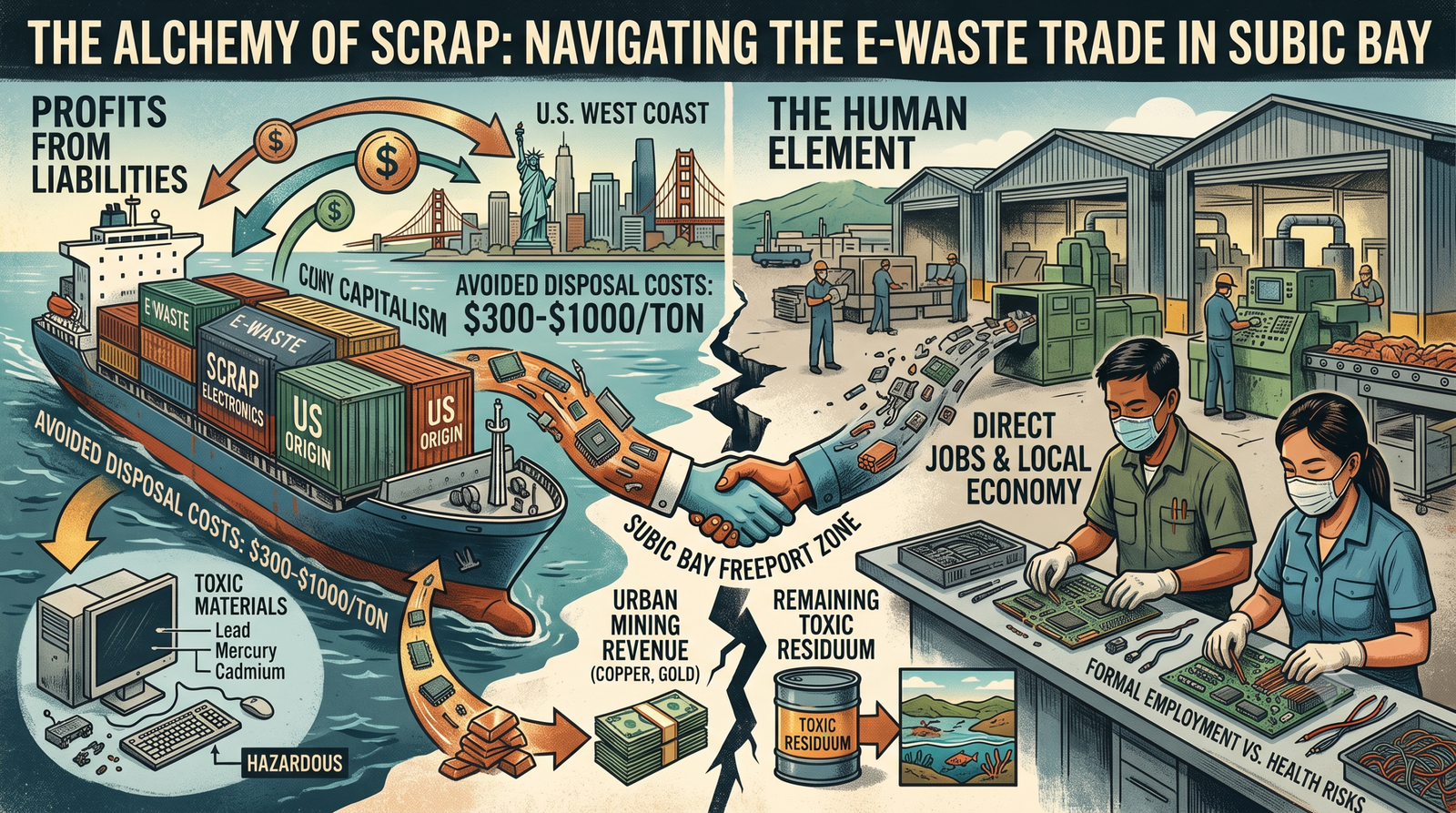
In the United States, safely recycling hazardous e-waste under strict environmental regulations is expensive, costing anywhere from $300 to over $1,000 per ton. For a waste generator, that is a heavy liability on the balance sheet.
However, if that same waste is boxed up and exported to a scrap broker overseas, the liability suddenly becomes a profit. Exporters can sell unsorted e-waste for $50 to $200 a ton. They clear their warehouses, make a modest return, and pass the environmental burden downstream.
The United States is one of the few industrialized nations that has not ratified the Basel Convention, an international treaty designed to stop developed countries from dumping hazardous waste into developing ones. Because the U.S. is not bound by the treaty, the export of these materials exists in a regulatory gray area, exploiting legal loopholes to reach shores like ours.
“Urban Mining” vs. Toxic Dumping
Inside the Subic Bay Freeport, local recycling locators have defended the imports as a vital part of the circular economy. They call it “urban mining.”
And in a strictly economic sense, they aren’t wrong. A single ton of high-grade electronic circuit boards yields significantly more gold and copper than a ton of raw mined ore. Operating with tax exemptions inside the Freeport, and utilizing a local labor force that is far less expensive than automated American plants, these facilities manually dismantle the scrap. The valuable metals are extracted and sold to global smelters, generating revenue and creating formal employment for residents of Olongapo and nearby towns.
For the man on the street—a father trying to put rice on the table or pay for his children’s schooling—a job at a sorting facility is a lifeline. It provides a steady income in a region where formal employment can sometimes be scarce.
But this economic opportunity comes with a quiet, lingering cost. Electronic waste is laced with lead, mercury, cadmium, and flame retardants. While the valuable gold and copper are exported back out, the toxic, non-recyclable residuals—chemical sludges and contaminated plastics—remain behind. If a facility cuts corners on safety protocols or ventilation, the workers bear the physical cost through respiratory issues and heavy metal exposure. Furthermore, the risk of chemical runoff poses a direct threat to the marine ecology of Subic Bay, which local communities rely on for both fishing and tourism.
Jam Lorenzo, deputy executive director of BAN Toxics, summarized the fundamental tension during recent protests: “The unimpeded entry of e-waste into Subic infringes upon our country’s regulatory authority over our territory. Such activities run contrary to the state policy of safeguarding the sovereignty, territorial integrity, and environmental protection embodied in our Constitution.”
A Line in the Sand
The tension between these two realities recently came to a head.
On July 22, 2026, the Bureau of Customs (BOC) at the Port of Subic took decisive action. Acting on intelligence regarding the MV Tokyo Express, authorities flagged three incoming containers declared as “scrap copper” from the U.S. Instead of allowing them to be offloaded, the BOC issued a “Retain on Board” order, citing the Philippines’ obligations under the Basel Convention. The ship departed a day later, taking the cargo with it.
Following this incident, the Subic Bay Metropolitan Authority (SBMA) clarified its stance. Armie Llamas, head of the SBMA Communications Department, stated, “The SBMA, in collaboration with the Bureau of Customs Port of Subic Bay, has denied the entry of suspected e-waste shipments originating from the US, a country that is not a party to the Basel Convention.” She added that as a signatory, the Philippines, through the SBMA, is committed to upholding the treaty’s provisions.
It was a significant victory for local environmental groups, including the EcoWaste Coalition and BAN Toxics, who have been sounding the alarm for months. Yet, the watchdogs have already flagged an additional 184 containers of suspected e-waste currently in transit, expected to arrive between August and September.
The inter-agency meetings now taking place between the BOC, the SBMA, and the Department of Environment and Natural Resources (DENR) will determine the future of this trade in our region.
Weighing the True Cost
The business of imported e-waste asks a fundamental question about how we value our resources and our people. There is undeniable ingenuity in recovering precious metals from discarded technology, and the jobs provided by these facilities matter deeply to the families who rely on them.
However, a truly fair economy does not require a community to trade its long-term health and the safety of its environment for short-term wages. Real prosperity involves honest accounting. As long as it remains cheaper for developed nations to ship their hazardous liabilities overseas rather than process them responsibly at home, the pressure on ports like Subic Bay will continue.
Finding a balanced path forward means ensuring that the pursuit of profit does not leave the heaviest burdens on the shoulders of those least equipped to carry them.
Editor’s Note: This article was prepared and structured with the assistance of artificial intelligence. All facts, quotes, and regional details have been directed, reviewed, and verified by the author to ensure accuracy, fairness, and alignment with verifiable events.
Leave a Reply