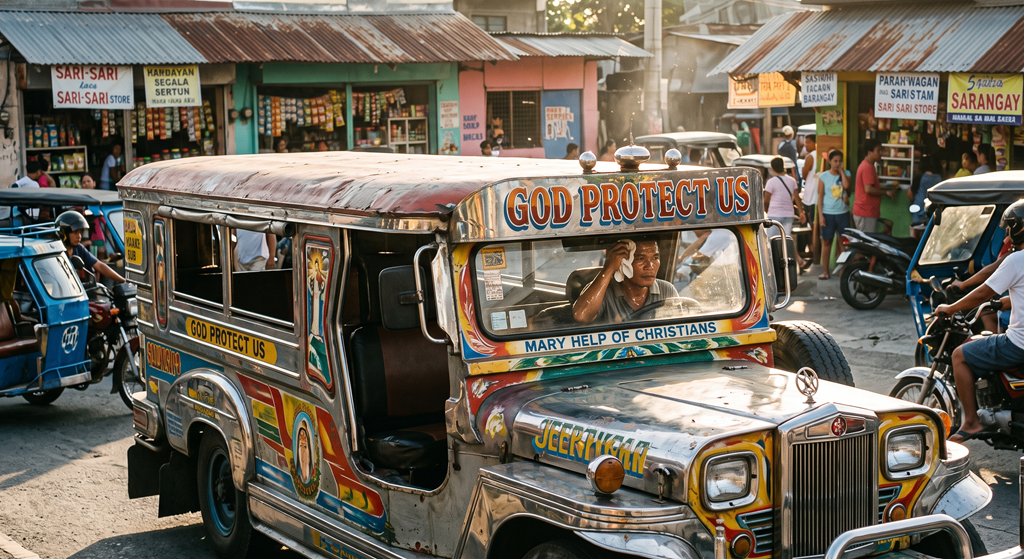
In the wake of World War II, the streets of Manila were left in ruins, and the public transportation system was practically nonexistent. When American forces departed, they left behind hundreds of surplus Willys military jeeps. Where others saw abandoned weapons of war, Filipinos saw an opportunity for reinvention.
Through sheer ingenuity and the quintessential Filipino spirit of diskarte (resourcefulness), these drab olive vehicles were stripped down, elongated, given galvanized iron roofs, and splashed with vibrant, kaleidoscopic colors. The modern jeepney was born, quickly earning its title as the undeniable “King of the Road.”
Colors with a Purpose: The Olongapo Innovation
While the wild, personalized art of the Manila jeepney is famous worldwide, the use of color took on a highly functional, disciplined role north of the capital. The system of color-coding jeepneys to identify specific passenger routes was actually pioneered in Olongapo City.
To bring order to the often chaotic nature of informal transit, Olongapo’s local government instituted a strict routing scheme. Jeepneys were painted in solid, uniform colors corresponding to their distinct zones—Yellow for the Sta. Rita route, Red for Gordon Heights, Brown for Cabalan, and Blue for Subic town. This ingenious, locally born system made the transit network instantly navigable for everyday workers and residents, proving that traditional jeepneys could be efficiently organized to serve a growing city.
The Engine of the Working Class
For decades, the jeepney hasn’t just moved the masses; it has fed the families of those behind the wheel. However, the economic reality of driving a jeepney is a daily, grueling hustle governed by the boundary system.
-
The Daily Grind: Drivers typically do not own their vehicles. Instead, they pay a fixed daily fee—the “boundary”—to the jeepney operator before they can claim any profit.
-
High-Stakes Hustle: A driver’s take-home pay is strictly what remains after the boundary and the day’s fluctuating diesel costs are paid. On a bad day with heavy traffic or low passenger turnout, a driver might work 12 to 14 hours in the sweltering heat and bring home barely enough to put a meal on the table.
Despite the hardship, the inside of a jeepney remains a unique microcosm of Filipino society. There is a deep, unwritten system of communal trust: passengers pass coins down the line shoulder-to-shoulder with the respectful phrase “Bayad po” (Here is my fare), and a simple tap of a coin on the metal roof signals the driver to pull over.
Progress vs. Heritage: The Modernization Threat
Today, the iconic Philippine jeepney is at a critical crossroads. The government’s ongoing Public Utility Vehicle Modernization Program (PUVMP) aims to phase out traditional jeepneys—many of which run on decades-old, highly polluting diesel engines—in favor of imported, Euro-4 compliant, or electric minibuses.
While the environmental and safety goals of greener transit are rooted in fact and necessity, the execution threatens the very working class the jeepney has always supported.
-
The Financial Chasm: A traditional jeepney is relatively cheap to maintain, but the new modernized units cost upwards of 2.5 to 3 million Philippine pesos.
-
The Debt Trap: For an average driver earning a marginal daily wage, taking on a multi-million peso loan is mathematically devastating. The requirement to join consolidated cooperatives has left many drivers fearing the loss of their autonomy, their routes, and ultimately, their livelihoods.
The Road Ahead
The jeepney is more than just a colorful, mechanical relic; it is a rolling monument to Filipino resilience and working-class grit. As the country wrestles with the necessary but painful steps toward modernization, the plight of the jeepney driver serves as a stark reminder: true progress must ensure that the very people who kept the nation moving for over seventy years are not simply left by the side of the road.
Leave a Reply